
Wood-Grain Aluminum baffle
I’ve been in this business for many years, and to be honest, I’ve seen far too many projects that had to be redone because the wrong materials were chosen. This is especially true for clients in the Middle East and Southeast Asia, where the weather is harsher than anywhere else. When selecting wood-grain aluminum baffle, it’s not enough to just look at how nice the sample looks—you have to see if it can hold up.
Realism of the Wood Grain and Consistency Across Batches
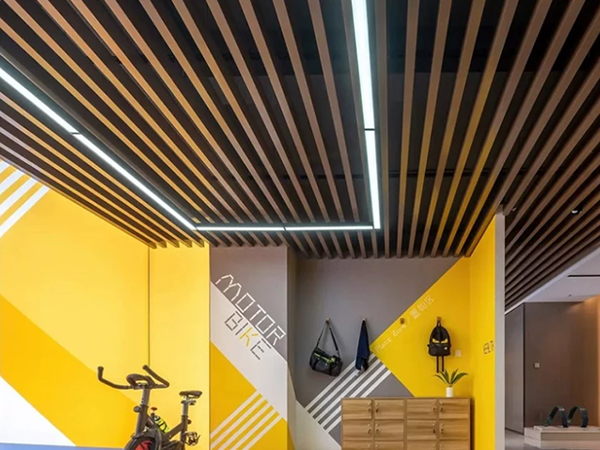
Let’s start with the realism of the wood grain.
When clients visit the factory, the first thing they look at is the sample. The heat transfer technology used for wood-grain aluminum profiles is indeed mature these days—the grain is clear and lifelike, and from a distance, it’s indistinguishable from real wood. But I generally don’t let clients place an order based on just one sample, because the real pitfall lies in “batch consistency.” Color variation, at its core, comes down to improper control of the curing temperature. If the temperature is too high, the color turns dark and yellowish; if it’s too low, it comes out too light. When panels from different batches are placed side by side, you can tell at a glance that they’re not from the same batch.
Our factory’s approach is to keep a reference sample from every batch, strictly control the coating thickness during the base coat application, stick with a fixed supplier for transfer paper without switching arbitrarily, and record the baking line temperature every half hour. You might not believe it, but these few steps alone can prevent 80 percent of the disputes that arise on construction sites.
Outdoor Weather Resistance and Aging Resistance
Speaking of outdoor weather resistance, this directly affects how many years your project will last.
I don’t need to elaborate on the intensity of sunlight in the Middle East, and the salt fog along the coast of Southeast Asia is no joke either. Surface treatments for indoor and outdoor use are two completely different matters. An indoor polyester powder primer with a wood-grain transfer finish will last over a decade without any issues. But if you’re installing it on curtain walls or outdoor walkways, you must use a fluorocarbon coating—or at the very least, an outdoor-grade transfer process. Fluorocarbon coatings offer significantly better UV resistance and chalking resistance than standard powder coating; they can withstand intense direct sunlight and acid rain erosion, and it’s entirely possible to maintain the color without noticeable fading for over a decade under normal use.
Some customers use indoor-grade materials for outdoor applications to cut costs. While no issues may be apparent for the first six months, the material will fade and turn white after a year. By then, replacing it is no longer just a matter of material costs—labor and project timelines are also lost.
Fire Resistance, Moisture Resistance, and Corrosion Resistance
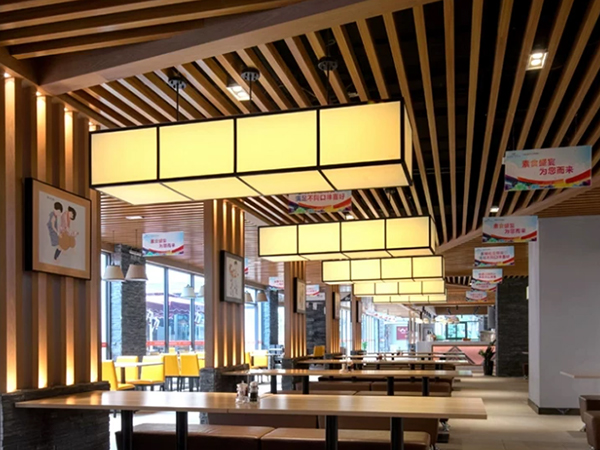
Fire resistance, moisture resistance, and corrosion resistance are, in fact, rooted in the same underlying principle.
Aluminum is inherently non-combustible, and wood-grain aluminum profiles meet Class A fire resistance standards, ensuring they pass fire safety inspections in public spaces.
Moisture resistance is even more straightforward: aluminum won’t rot even when submerged in water. In regions like Southeast Asia with long rainy seasons and high humidity, or in spaces such as kitchens and underground parking garages, wood-grain aluminum profiles are completely unaffected.
Corrosion resistance relies on aluminum’s inherent resistance to oxidation and the density of its surface coating. One detail is often overlooked: in coastal projects, if the base material contains excessive impurities or the coating has pinholes, salt spray can seep in through the gaps, causing white rust to form at the cut edges over time. Therefore, for coastal projects, we generally select 3003 aluminum-manganese alloy as the base material, which offers better inherent corrosion resistance than ordinary pure aluminum.
Comprehensive Customization Capabilities
Finally, let’s talk about customization—this is where suppliers truly set themselves apart.
Base widths from 20 to 400 millimeters, heights from 20 to 600 millimeters, thicknesses from 0.4 to 3.5 millimeters, and lengths up to 6 meters that can be cut to any size—these are standard operations. What truly tests a factory’s capabilities are non-standard items. If you need curved, wavy, or irregularly shaped pieces, anything that machines can’t form must be bent by hand. If you need a specific wood grain—for example, a client brings a walnut sample and says, “Make it exactly this color”—we have to re-adjust the base color and test the transfer parameters. We won’t dare to produce in bulk until the prototype is confirmed.
Then there are perforated acoustic panels: drilling holes in the base panel and applying acoustic foam can boost the NRC coefficient, but hole spacing, diameter, and layout all affect the final result, so we must thoroughly review the drawings with the design team. When it comes to customization, there’s no such thing as “close enough.” A two-millimeter difference in dimensions means the battens won’t line up on-site, and the logistics costs for replacement shipments and the lost construction time are far more expensive than the materials themselves.
After years of handling export orders, my biggest insight is this: clients in the Middle East and Southeast Asia don’t just look at price. They’re afraid that while the first batch might be good, the second batch won’t be the same; they’re afraid that while the sample passes inspection, the bulk order won’t; and they’re afraid that if a problem arises, they won’t be able to find anyone to hold accountable. Wood-grain aluminum profiles aren’t high-tech products, but excelling in all three areas—batch consistency, outdoor weather resistance, and on-time custom delivery—relies on the painstaking effort on the production line. When selecting a supplier, asking one extra question—“Do you still have the reference sample from the previous batch?”—is more useful than reviewing ten brochures.


Leave a Reply
Want to join the discussion?Feel free to contribute!